
More Than Produce: Clean Water and Youth Leadership Bloom at Ruth’s Garden
By Adam Chalifoux
It’s 90 degrees in Moorhead, Minnesota, today. While the region is known for its colder climate, summer is here and making its presence known. The late-morning sun shines bright overhead at the First Congregational Church for Christ.
On the North Side of the Church, there are a few benches in a clearing beneath the canopy of trees, providing a cool spot in the shade on a hot day. A man lies on a bench with his bike resting against it next to the clearing. Directly up against the exterior wall of the old cathedral is a garden being tended to by a small group made up of a handful of teenagers and a couple of adults.
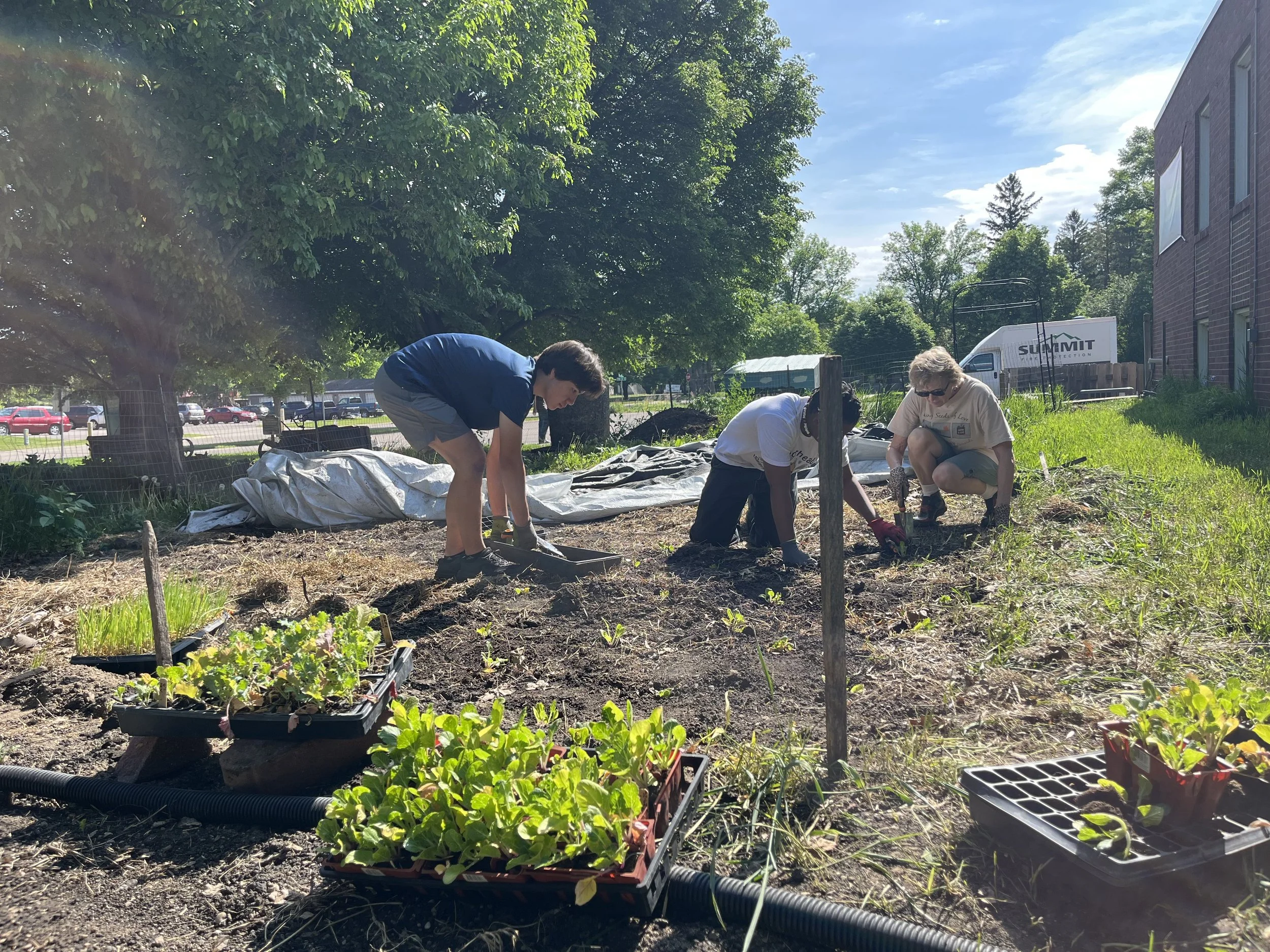
Church members and Youth Stewards tend to Ruth’s Garden
The group is part of a program that helps to connect nutrition to communities, teaching youth how to farm for market. The roots of this group run deep enough to predate the City of Moorhead, all the way back to the Book of Ruth, which inspired the garden’s name.
“So we call this Ruth’s garden, you know the book of Ruth,” says Reverend Michelle Weber, “in the book of Ruth, Ruth and Naomi survive because they glean off the corners of the fields, right.. and in the Jewish scriptures there is a command to leave the corners fallow so people who don’t have enough to eat can eat. So, you don’t harvest the corners of your field. So, this is the part of our property we set aside to feed other people.”
The garden is part of a coalition of similar gardens unified by the Food and Ecology Partners, a program of the Prairie Institute. Youth Stewards leads this garden, teaching participants about agriculture, sustainability, and horticulture while helping them grow as leaders and farmers alongside the plants they tend.
“We’ve been planting a bunch of lettuce, red lettuce, chives, onions, and things like that, and I think it’s really nice,” says Youth Steward, Skye Dill.
One of the key tenets of the program is teaching how to garden for market.
“Gardening for market is a possible hobby or career for them,” says Weber, “and one of the things you have to do to garden for market is you have to control who comes into your garden. And you have to adhere to certain health and safety guidelines in the garden.”
The produce from the plot goes into a cart facing the eastern parking lot.
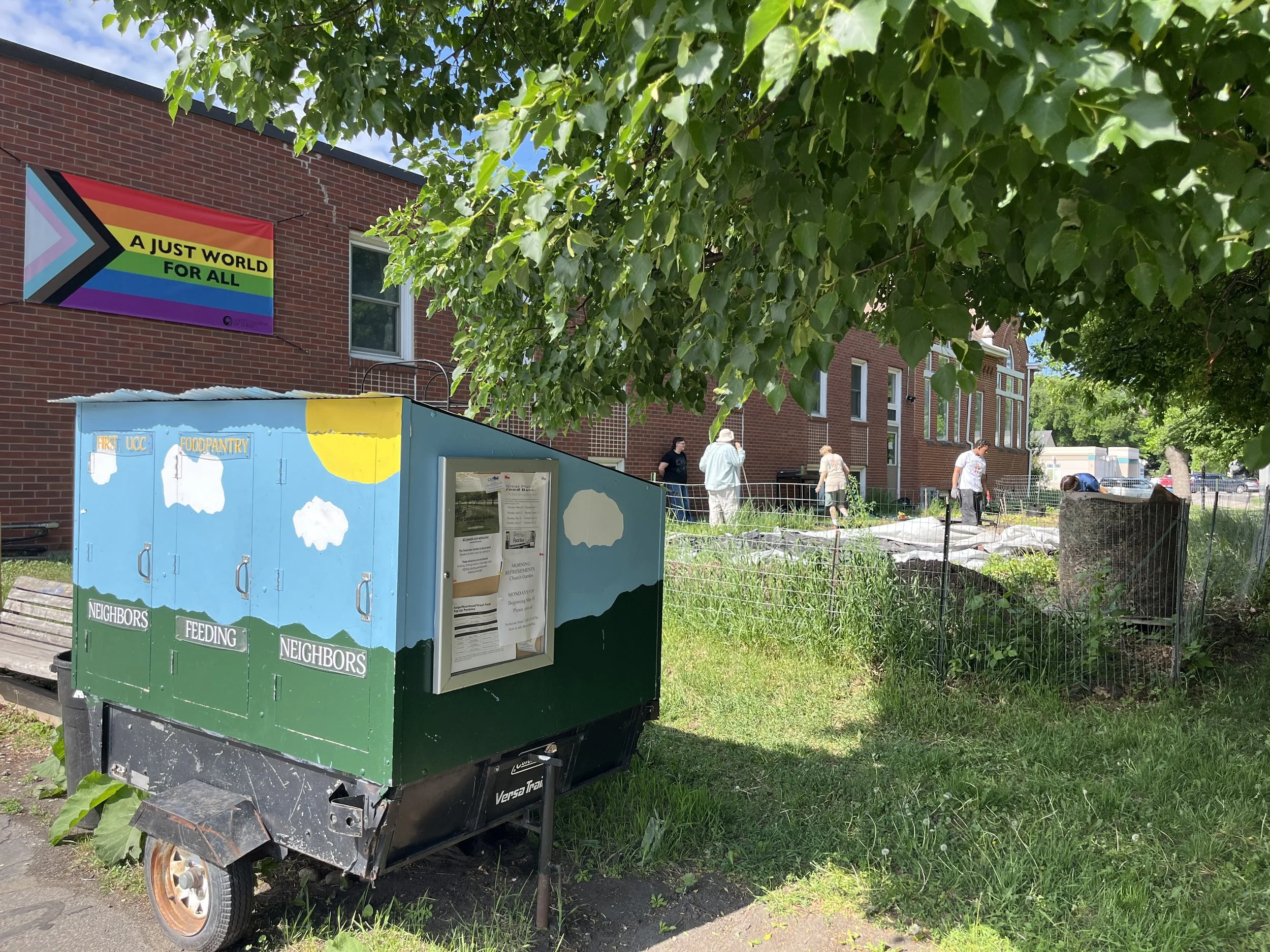
Ruth’s cart, stocked with food, is parked just outside Ruth’s Garden
“This is Ruth’s cart,” says Weber, pointing to a trailer with a landscape painted on it, “so Ruth’s cart is filled once a day by Church members and other community folk come and put stuff in there."
The cart serves as a mini food pantry.
“Free use, we don’t take any information, there is no barrier, and people use this every day, all day,” says Weber. “Literally, we put something in there, and we come back an hour later, and it is empty.”
Finally, here lies the rub. In the garden, there is a water faucet.
“Imagine you don’t have your own living room,” says Weber, “and it’s a hot day and you walk in here and the trees give you shade and its cool there are benches you can relax on you know as long as its daytime no one is going to chase you out of here we’re happy to have this space that we can share in that way.”
But you are still very thirsty. It’s 90 degrees out, you just walked a few miles, and see the opportunity for a cool drink of water. Likely unbeknownst to you, however, is that if you walk into the garden to get water from the faucet, the food in the garden is no longer market-ready and can’t go into the cart that you just grabbed some food out of.
Sahan Nagodavithana is a member of the Youth Stewards program and has been gardening here for around ten years. Going into his senior year at Moorhead High, he is also a state-qualifying swimmer for the Spuds. Nagodavithana noticed this problem and led the charge to provide a solution.
“Started with unhoused people sleeping around here", he said, “and we have our water faucet outside the church for watering the garden, and homeless people would just come inside (the garden), turn it on, drink from it, but they don’t always turn it off, so water leaks into the basement, and we have a problem with that. So, I decided for my Eagles Project for Boy Scouts that I had to solve that situation and create water for the unhoused people outside of the garden,” he said.
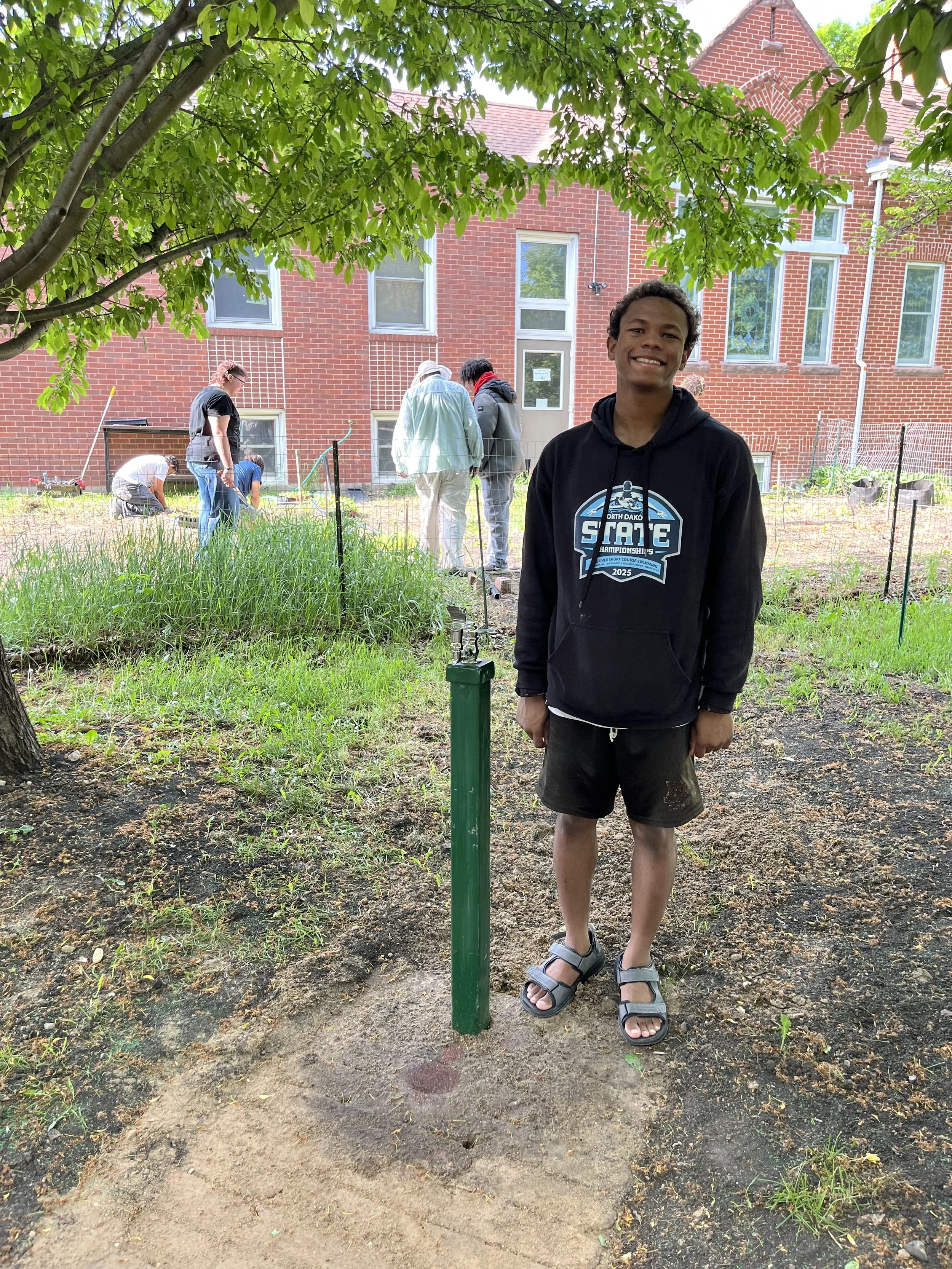
Sahan Nagodavithana stands beside his completed Eagle Scout project
Now, outside the garden, near the center of the peaceful oasis, stands a green pole about 3 feet above the ground, complete with a working water fountain at the top.
“My mentor, he built the pole and faucet attached to it, then we went to Menards to grab sand, rocks, and some seeds for the grass to grow after we were done digging the trench for the pipe that goes into the church … and my troupe, 637 came and helped me dig up the trench for the pipe and lay down the sand and rocks for the base for the faucet.”
Shortly after the project was completed, Pastor Weber says she saw one of the first to use the faucet, so pleased with the new amenity that he did a celebration dance.
“I feel really good about it, so we don’t have to worry about our basement leaking,” said Nagodavithana, “and we also don’t have to worry about whether homeless people are not getting enough water, and clean water too.”
Alisha Haman, a parish member, sits by the garden enjoying the shade.
“During the summertime, even with all the shade, it gets a little warm here,” said Haman, “but it makes it so much nicer for all the people that come and sit down and relax, especially for all of our homeless people that come sit and relax here. It makes it easier for them to get something to drink when it is so hard for them to get anything to drink around here. “
According to a Texas A&M study, about 27 million Americans struggle with clean water access, with low-income communities experiencing high exposure to contaminated water.
Apart from fresh produce and clean drinking water, one of the mainstays at Ruth’s Garden is young leaders.
“Throughout the summer, I do less and less...” said Weber, “I can pull back. We have three intensive training weeks. Last summer I co-directed, this summer I am just doing this garden, but by the third week, Corey and I, the other co-director, had to do very little because what the leadership interns and the stewards were doing; that’s cool to see.”
As the sun rises closer to noon, a woman on her bicycle drives up to Ruth’s cart and gathers some produce and bread before riding off. Meanwhile, in the garden, eight gardeners work towards restocking it.
When asked if he had any advice for people who are looking for a way to help in their own way in their communities, Nagodavithana offered the following advice:
“If you can give help, give as much as you can and don’t be afraid to ask for help.”
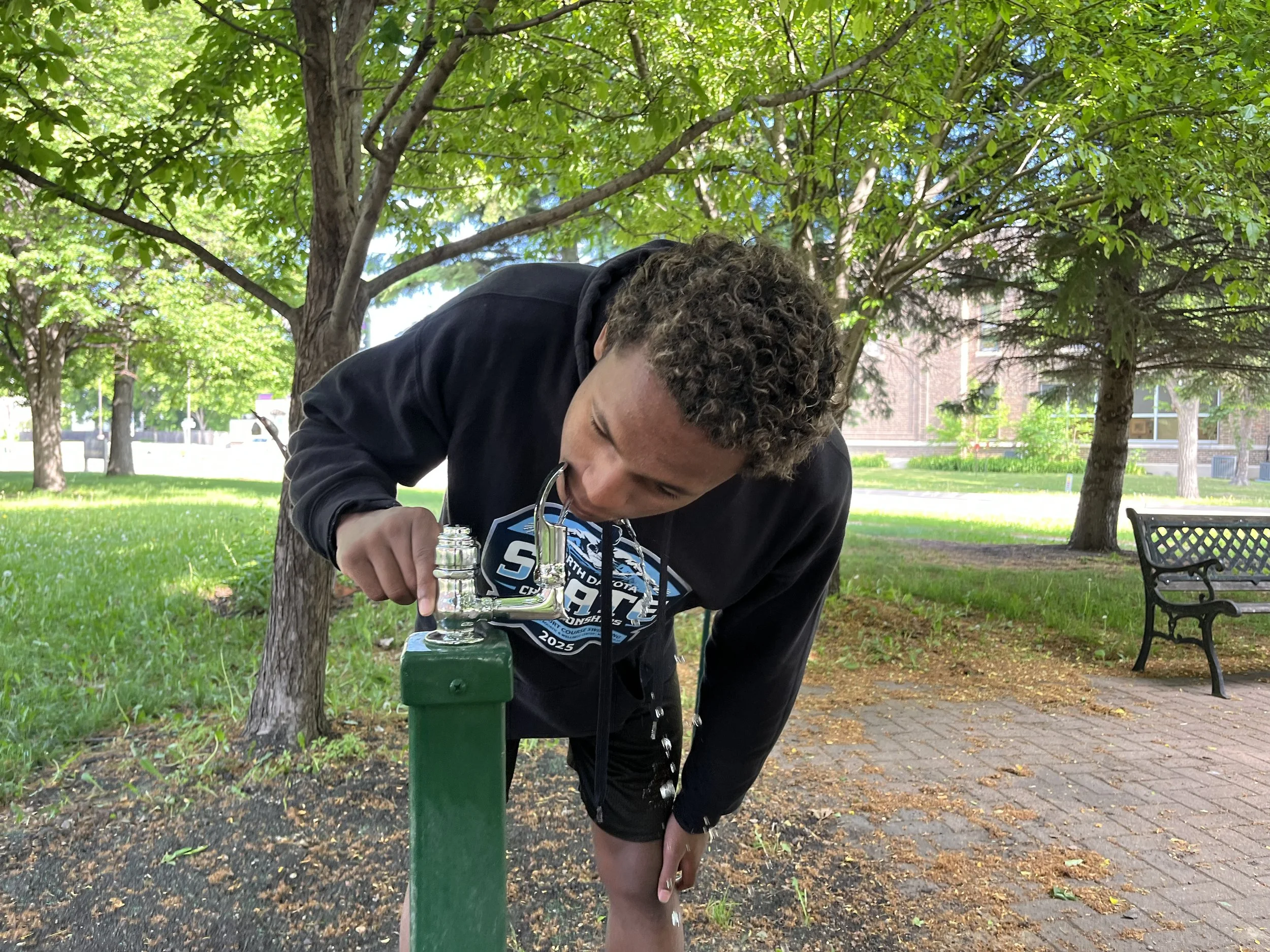
Sahan Nagodavithana enjoys a cold drink from the new fountain at Ruth’s Garden