
County fund that helps residents in financial pinch dries up early
Emergency General Assistance funds help residents after fires, theft, job loss or other crises — no funds are available until July 2026

By Melissa Van Der Stad for Churches United
Clay County residents in crisis will no longer have Emergency General Assistance funding to turn to.
The state funding that powers this community assistance tool has run out for the year, according to Karen Amundson, financial assistance supervisor with Clay County’s Family Service Center.
It’s never run out this quickly before, she said. There won’t be more money from the state until July 1, 2026.
“We’re out of funding,” Karen told Churches United. “We are no longer accepting applications as of today. It stinks because there is still a need.”
Over the years, Emergency General Assistance (EGA) funds have been a parachute for many Minnesotans in crisis.
This financial support is given out by Clay County to residents after a house fire or to people facing utility shut-off, eviction, illness, theft, loss of a job or other life-impacting problems, according to Clay County’s webpage.
For years, Clay County has provided EGA funding to people who don’t qualify for Emergency Assistance – meant only for adults with children in the household – or Emergency Minnesota Supplemental Aid, which is intended for people receiving Minnesota Supplemental Assistance or Group Residential Housing.
The need in the community is prevalent.
Clay County receives anywhere from four to eight applications for emergency assistance per week, Karen said.
While the number of requests fluctuates each year, she said, one large impact Clay County is seeing is that the cost of meeting each individual application for emergency funds has risen due to the rising cost of both rent and utilities.
Funding for EGA grants comes entirely from the state of Minnesota.
During the 2025 fiscal year, Clay County received $48,784 in EGA funding from the State.
That number was predetermined, Karen said, based on the average amount of EGA funding Clay County used over the last three years.
However, Karen said, that algorithm isn’t keeping pace with the needs of Minnesota communities due, in part, to the aftershocks of the Covid-19 pandemic.
For a time, the pandemic halted evictions in the state and brought federal money flooding into communities to keep economies afloat. As a result, fewer residents relied on EGA assistance to keep their housing because they weren’t at risk of eviction, and there were plenty of federal assistance dollars to help people in crisis.
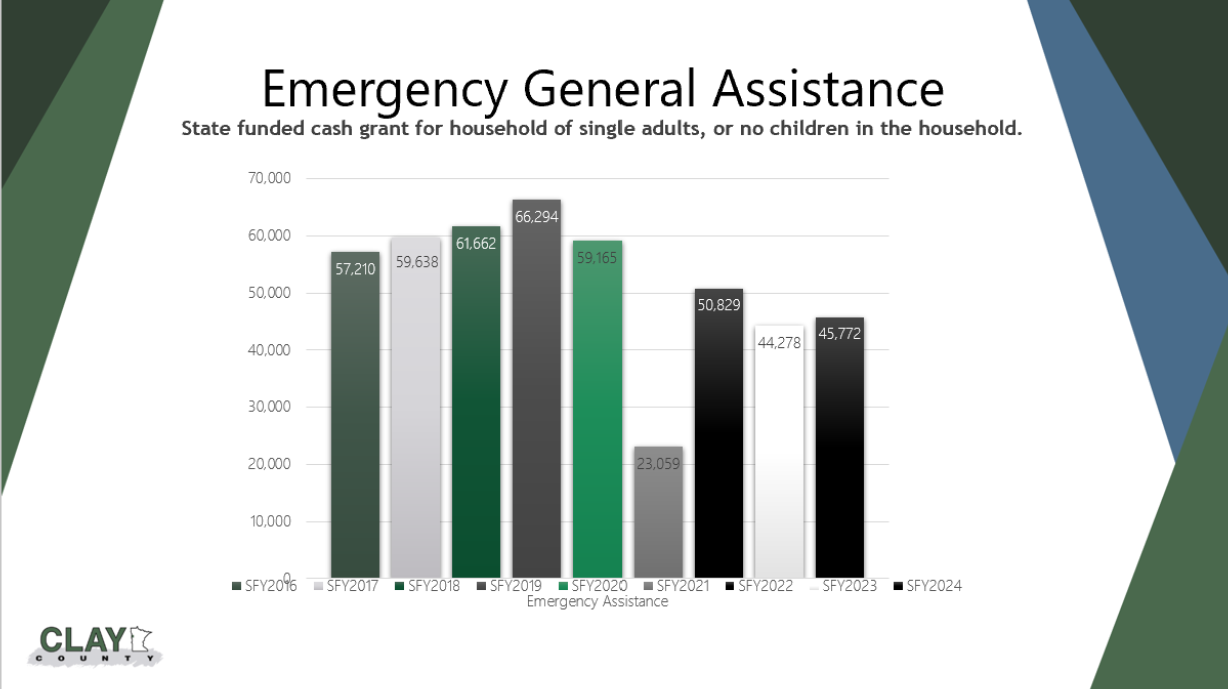
That resulted in a snowball effect, she said, with a decrease in the amount of state money each county received this year for EGA expenses.
“In the last couple of years we have actually seen less money in our funding and a higher need in the community,” Karen said.
EGA funds are only to be used when a Clay County resident faces “a direct, immediate threat to the physical health or safety of the applicant,” according to the Minnesota House Research Department. Those basic safety needs include food, clothing, shelter and utilities.
In 2024 and 2025, the state of Minnesota spent $6.7 million each year in funding on EGA programs, according to the Minnesota House Research Department. That $6.7 million was then divided up amongst all 87 counties in the state.
Of those, 46 counties spent more than 90% of their allocated assistance funding on their residents, and a total of 20 counties overspent their pool of money.
When a Minnesota county exceeds its limit on assistance spending, according to the Minnesota House Research Department, the county government is responsible for covering the difference.
Covering any extra EGA costs isn’t a possibility for Clay County this year, Karen said, noting that the 2025 budget doesn’t have the flexibility to absorb additional costs.
“This unfortunately impacts our residents who live on a fixed income and could be just one crisis away from not being able to pay all of their bills,” Karen said. “We also have to be diligent on how we spend our EGA funds because if we overspend, then the county will be responsible for the overage. With the budget already tight, we don’t want to burden the tax-payers with more.”
Between January of 2025 and November of 2025 the Clay County team helped 66 different people through a crisis with the $46,000 in EGA funding given to them by the state of Minnesota, Karen said.
Thirty Clay County residents were allocated an average of $717.50 per person to prevent their utilities from being shut off for a total of $21,000; 11 people were granted $684 apiece for damage deposits for a total of $6,800; and 24 people received housing/rent assistance at around $740 each for a total of $17,700.
Each person can only be granted EGA assistance once every 12 months.
It’s common for Clay County to spend all its allocated EGA funding each year, Karen said.
What’s uncommon, however, is how quickly it happened this year.
Typically, the EGA funding pool is large enough – and the demand low enough – that Clay County can support residents who have an emergency from the time the funding is allocated in July all the way through the winter months.
Funding typically runs out around February, Karen said, leaving the community without EGA help for about 5 months rather than the 8 months that Clay County is currently experiencing.
With windchills last week reaching as low as -40 degrees, the risk to any Clay County neighbor who finds themselves improperly sheltered or without utilities is high. In recent years, nonprofits throughout the metro have reported being overwhelmed with the rising demand for emergency housing and shelter assistance for men, women and children alike.
While Clay County is no longer assisting people with EGA funding, Karen said, households with at least one minor child can still apply for an EG benefit. While EGA funding is entirely dependent on the Minnesota Legislature, EA balances are funded by both federal block grants and supplemental state dollars.
Clay County residents facing a crisis who don’t have any minor children in the home will need to turn to other agencies to assist them, she said, at least until July, 2026.
Once that fiscal year starts in July, the county will once again be able to provide EGA funding to local residents.
How much funding is available next year, however, is still unknown. That decision will occur as part of the state Legislature’s budgeting process.
Looking forward, Karen said, Clay County will continue to try and assist as many people in crisis as they can with the money allotted.
“If our clients would come in sooner and not wait until (the) last minute, we may be able to help them before it takes so many dollars,” Karen said in an email. “If the landlords could talk to the clients about the past due balances before it gets 2-3 months behind would also help. Our funding would go a lot further if we could resolve the emergency by paying just one month past due instead of multiple months.”