Fargo’s First Lutheran hosts ‘Getting it Right in the Call to End Homelessness’ event
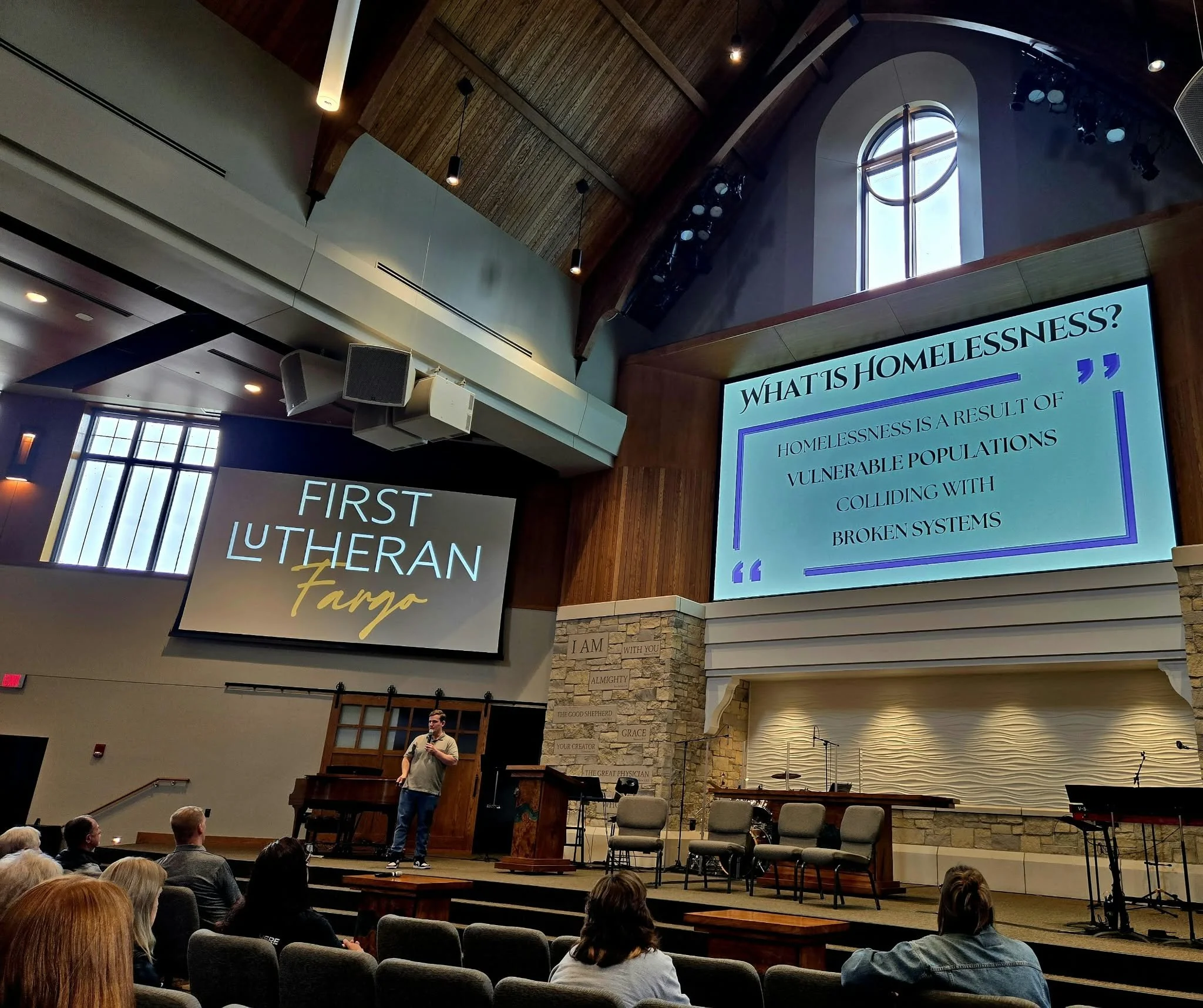
Kevin Nye addresses the crowd on Saturday, October 3, inside First Lutheran Church as part of the ‘Getting it Right in the Call to End Homelessness’ event.
FARGO — People of faith and homeless experts alike gathered over the weekend to explore ways to address the rising prevalence of homelessness in our community.
“This community truly cares about our neighbors’ experiencing homelessness,” said Pastor Devlyn Brooks, CEO of Churches United. “Saturday’s gathering was God’s love in action.”
During the keynote address, writer and homelessness advocate Kevin Nye spoke about solutions, barriers, and God’s grace on Saturday, October 3, inside First Lutheran Church at 619 Broadway N, Fargo.
The road to Fargo-Moorhead
The First Lutheran Church congregation resolved to bring Nye to Fargo-Moorhead after reading Nye’s first book — Grace Can Lead Us Home: A Christian Call to End Homelessness.
Churches United was only too happy to sponsor the event with the help of New Life Center and the FM Coalition to End Homelessness.
“We were honored to partner with First Lutheran Church for their event: ‘Getting it Right in the Call to End Homelessness,” Pastor Brooks said. “Our community can move mountains when the people of faith come together.”
Local service organizations — including the Churches United team! — tabled at the event and attendees had the opportunity to talk face-to-face with the people working in homeless services while also learning about leading solutions from Nye during the keynote speech.
Embody God’s grace
Nye began by talking about the theological commitment of Grace: shown by God to all people.
“As people of faith we are called to embody that same grace,” Nye said.
When it comes to people experiencing homelessness, Nye said, too often that grace in people’s hearts runs out. This is especially true for people of faith, Nye said, pointing to a study by The Washington Post and the Kaiser Family Foundation that found that Christians are more than twice as likely to blame a person’s poverty on personal effort.
It’s too common to assume that homelessness stems from an individual’s lack of effort rather than a series of unfortunate circumstances, he said.
“Homelessness is a result of vulnerable people colliding with broken systems,” Nye said. “Love thy unhoused neighbor.
After working in direct homeless services for over a decade, Nye decided to take his work nationwide by co-founding the National Faith Coalition to End Homelessness. This organization strives to connect faith communities across America together with a common purpose: strengthen our response to homelessness.
“Homelessness is rising across this country, and most communities already have systems designed to address it,” the Faith Coalition’s website said. “What those systems often lack is the kind of broad community partnership — the trust, the reach, the moral weight — that faith communities are uniquely positioned to provide.”
Solutions:
Over 20 years ago, the U.S. Department of Veterans Affairs worked on a bipartisan bill to provide every veteran experiencing homelessness with a housing voucher. Over the last two decades, veteran homelessness has been reduced by 80%, Nye said.
“Homelessness is a housing problem,” Nye said.
Without enough affordable housing in the United States, the first people displaced and left outside will be the most vulnerable: people navigating job loss, mental illness, healthcare needs, substance abuse, old age, disabilities, or domestic violence.
When discussing homelessness, he said, people focus too much on the vulnerable populations and not enough on the “broken system”.
“If we solved the system problem the vulnerability problem would be easier to solve because people will be able to sleep inside,” Nye said.
Between 80 – 90% of people moved right into housing with robust services stay in their homes, Nye said.
“Stability leads to success,” Nye said.
In Moorhead, Churches United operates two permanent housing apartment buildings: Bright Sky for individuals and families and Silver Linings for people over the age of 55 and veterans. All the people who call these buildings home have a lived experience of homelessness.
Turn an ‘I’ into a ‘we’
On the national level, Nye said, decades of a declining number of HUD subsidized housing units, rising rental costs, and stagnating wages have caused the sharp rise in homelessness that we are navigating today.
“People cannot afford to live on the income that they have, and the government stopped making up the difference,” Nye said. “This is a problem that has been 40 years in the making.”
“The first thing I tell people when they ask what can I do about homelessness?” Nye said. “We need to turn an ‘I’ into a ‘we’.”
Nye suggests the solution is simple: engaged voters who show up, again and again, to call for more affordable housing in the community.
“Homelessness ends with housing,” Nye said. “Housing only happens when we remember that we all belong to each other… it has to start with changing our hearts.”